
Rethinking Business Education: What Role Do Business Schools Play in Labour Exploitation?
How much do business schools talk about the people behind the products, services and profits that businesses create?
This question was at the heart of a recent conversation on BFM featuring Dr Priya Sharma, Associate Professor and Head of the Centre for Commercial Law and Justice (CCLJ) at Sunway University.
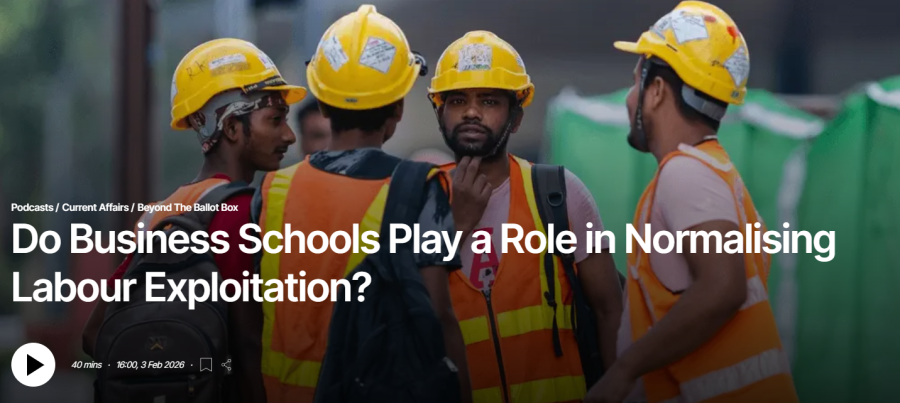
The discussion explored the often-overlooked connection between business education, corporate success and the exploitation of labour, particularly the experiences of migrant workers who can find themselves in conditions resembling modern-day slavery.
While conversations about labour exploitation often focus on workers at the bottom of global supply chains, the episode asks a broader question: what role should business schools play in preparing future business leaders to recognise and respond to these realities?
Dr Priya discussed the importance of looking beyond traditional ideas of business success and profitability and considering how business education can engage with questions of corporate responsibility, human rights and the realities faced by workers across global supply chains.
The conversation also drew on themes explored in Combatting Modern Slavery: A Global Perspective, a book co-edited by Dr Priya Sharma and published by Springer Nature. The publication brings together global perspectives on modern slavery and examines the legal, institutional and practical challenges involved in addressing exploitation.
The discussion offers an opportunity to think more broadly about what business education should prepare students for, and how future business leaders can better understand the human impact of corporate decisions.
At Sunway University, conversations such as these reflect the importance of connecting business and legal education with the realities of the world in which future professionals will work. Understanding how corporate decisions affect workers, communities and wider society is an important part of preparing graduates to lead responsibly.
The full conversation is available on BFM’s website and Spotify.