
Subang-Sunway Education Corridor A World-Class Tertiary Option: Triple Alliance Featured in The Edge Malaysia

WHAT was once a vast tin mining wasteland, dubbed by sceptics as a site of either "great vision or hallucination", has been transformed over the past four decades into one of Malaysia's most concentrated higher education ecosystems.
Today, the Subang-Sunway education corridor stands as a primary driver of Selangor's knowledge economy, anchored by three major tertiary institutions: Monash University Malaysia, Sunway University and Taylor's University.
As the corridor looks towards the mid-century mark, the traditional boundaries separating academic lecture halls, private enterprise and municipal urban design are rapidly dissolving.
Driven by cross-institutional alliances, industry co-created curriculums and multimillion-ringgit research grants, the corridor is transitioning to a seamless "open campus" model. The surrounding township functions as a living laboratory, bridging the gap between talent development and industrial execution.
FROM TIN MINING WASTELAND TO TERTIARY POWERHOUSE
The origins of the Subang-Sunway knowledge corridor trace back to the mid-1980s, an era defined by a severe economic recession. At the time, middle-class Malaysian families struggled to fund their children's overseas education, while public universities faced capacity constraints.
Recognising the crisis, the federal government issued a call to private business conglomerates to step in and facilitate tertiary access.
Tan Sri Jeffrey Cheah, founder and chairman of Sunway Group, answered that call by founding Sunway College in 1987. To help lower the cost of acquiring foreign qualifications, Sunway pioneered early "twinning" programmes, partnering with international institutions such as Monash University in Australia, as well as the University of Leicester in the UK and Western Michigan University in the US.
"This area was a wasteland back then, a desolate piece of land, a former tin mine where basically nothing grew," recalls Prof Datuk Dr Elizabeth Lee, CEO of Sunway Education Group.
"The bankers who were with Tan Sri [Jeffrey Cheah] at the time were sceptical when he told them of his vision to develop the area. Today, not only has Sunway transformed from a wasteland into a wonderland, but it is also a sustainable city with not one but three thriving universities."
The establishment of Monash University Malaysia in 1998 marked a crucial milestone, representing the first international branch campus to open in Malaysia, built in partnership with the Sunway Education Group. From an initial intake of fewer than 300 students 26 years ago, Monash University Malaysia has expanded into a major research-intensive campus.
"By the end of last year, we had almost 14,000 students enrolled across the year," says Prof Stephen Boyle, vice-president (education) of Monash University Malaysia.
"Predominantly, they are undergraduate students — about 12,000 undergraduates straight from school — but we are starting to see substantial growth in postgraduate master's degree students and graduate research students, particularly post-Covid-19, over the last three years, where we have seen quite substantial growth in students coming [from overseas] to study here."
"It would be terrible to train a student to enter the workforce without any idea of how to leverage AI. Why do manual work if it can be automated? Students must learn to use AI ethically and efficiently to deliver higher-level value."
— Lee, Sunway Education Group
THE TRIPLE ALLIANCE
Rather than engaging in destructive market competition, the three primary universities in the area — Sunway, Monash and Taylor's — formalised a collaborative framework known as the Triple Alliance. Initiated with seed capital provided by Cheah and the Jeffrey Cheah Foundation, the alliance is jointly funded by the three institutions to maximise operational and academic synergies across the township.
At the heart of this academic ecosystem is the Triple Alliance Joint Research Grant (TAJRG). To eliminate academic silos and ensure practical commercial relevance, every proposal submitted for TAJRG funding must meet strict cross-institutional criteria.
"Every funded proposal is required to involve researchers from all three universities and at least one industry collaborator," explains Sunway Education Group's Lee.
Beyond high-level research, the Triple Alliance translates into day-to-day resource sharing that underpins an open campus experience for students. The current operational integration includes shared information literacy modules across university libraries, joint librarian training, joint ICT procurement to leverage collective purchasing power and shared cybersecurity threat-monitoring networks.
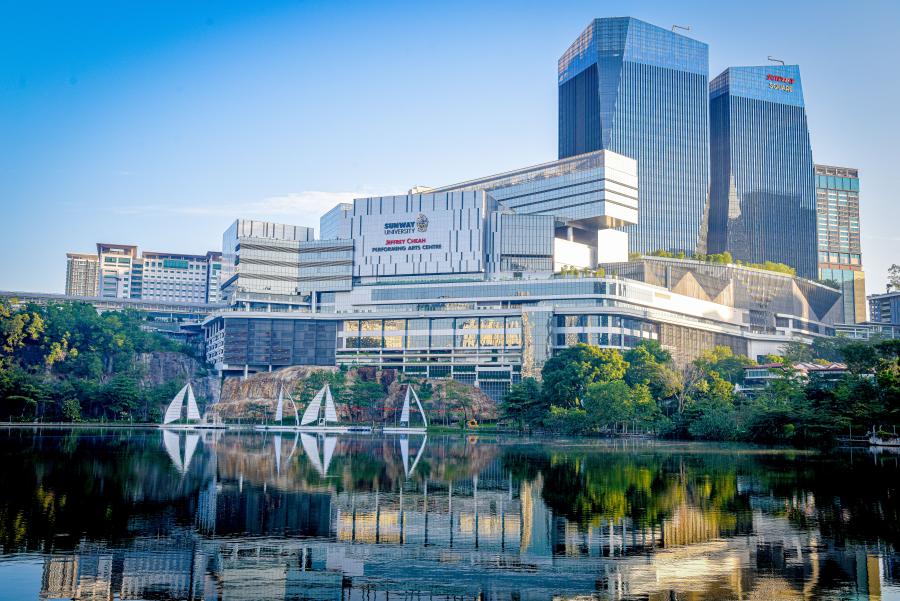
Physical infrastructure is similarly shared. The Jeffrey Cheah Performing Arts Centre at Sunway is accessible across campuses for cultural events, while joint student activities include cross-campus entrepreneurship hackathons, start-up bootcamps, the Triple Alliance Philharmonic Orchestra and the annual Triple Alliance Games (formerly the Trident Games).
To accommodate round-the-clock study habits safely, Sunway collaborated with commercial bookseller BookXcess to establish a 24/7 facility where students can study within walking distance of both Monash and Taylor's campuses.
CURRICULUM CO-CREATION
A central challenge facing tertiary institutions worldwide is the accelerating pace of technological displacement. Skills taught during a student's first year can quickly become obsolete by graduation. To address this gap, institutions along the corridor are restructuring how curriculums are designed and executed.
Monash University Malaysia has established an Industry Advisory Board for each of its academic schools. These advisory boards conduct ongoing surveys and design thinking workshops with corporate representatives to continuously evaluate programme content.
"Co-creation of curriculum with industry stakeholders is becoming increasingly important. We run workshops with representatives from specific sectors to get their direct input on what we should actually be teaching, ensuring our programmes move beyond theoretical frameworks to offer practical applications."
— Boyle, Monash University Malaysia
"Co-creation of curriculum with industry stakeholders is becoming increasingly important," says Monash's Boyle.
"We run workshops with representatives from specific sectors to get their direct input on what we should actually be teaching, ensuring our programmes move beyond theoretical frameworks to offer practical applications. In some cases, large companies co-develop programmes where students split their time directly between the corporate environment and the campus."
He emphasises that as artificial intelligence (AI) automates baseline technical tasks, university education must pivot to fostering distinctly human "enterprise skills".
Meanwhile, at Sunway, Lee says students are actively encouraged to use generative AI tools from day one. "I get asked, 'How are you preventing your students from using AI?' I tell them I don't; I encourage them to use it.
"It would be terrible to train a student to enter the workforce without any idea of how to leverage AI. Why do manual work if it can be automated? Students must learn to use AI ethically and efficiently to deliver higher-level value."
MACROECONOMIC MULTIPLIERS AND THE TRANSITION TO BRAIN GAIN
The economic impact of the Subang-Sunway corridor extends well beyond academic tuition, serving as a primary driver of municipal commercial activity, employment and urban mobility.
Monash University Malaysia directly employs about 1,000 academic and administrative staff members, while its 14,000-strong student body generates sustained local demand across housing, public transit, food services and retail. Furthermore, biannual graduation ceremonies attract thousands of family members from Malaysia and overseas, filling regional hotels and driving up hospitality revenues.
The physical integration between the universities and the surrounding township is heavily reliant on urban walkability. Secure, elevated pedestrian walkways connect campuses directly to Sunway Pyramid, Sunway Square, residential precincts and transit hubs, allowing students to navigate the township safely without having to rely on private vehicles.
"It is entirely symbiotic. We need the surrounding ecosystem for our university to thrive," says Lee.
From a demographic perspective, the corridor plays a crucial role in international talent attraction. About 45% of Monash University Malaysia's student population originates from overseas, drawn primarily from Asian markets seeking the same time zone and high-quality qualifications. Meanwhile at Sunway University, international students account for 20% of the student population, representing over 100 nations.
This international presence has shifted the policy narrative from reversing the historical "brain drain" to capturing regional "brain gain". Both institutions actively participate in exchange networks.
Monash Australia operates a Global Immersion Guarantee programme, bringing 800 Australian undergraduate students to Malaysia annually across two-week immersion modules, alongside single-semester exchange options for domestic students.
Sunway maintains strategic partnerships with leading global institutions, offering short-term study opportunities at the London School of Economics (LSE), University of California, Berkeley and Lancaster University, while collaborating on research with the University of Cambridge and the University of Oxford.
TECHNOLOGY TRANSFER AND COMMERCIALISATION
As the corridor matures, university-led innovation is expanding beyond basic academic research to formal commercialisation, intellectual property (IP) generation and alternative talent pathways.
To bridge the gap between academic lab discoveries and commercial deployment, Monash University Malaysia established a dedicated pre-commercialisation funding mechanism. This framework provides early-stage seed funding, market validation support and Cradle Fund grant linkages to transform university IP into viable market technologies.
One of its success stories is First Chip Sdn Bhd, a university spin-off specialising in sensor chip technologies for the semiconductor sector.
"Researchers are naturally focused on solving technical problems, but recognising commercialisation value requires a distinct skill set," says Boyle.
"Through our pre-commercialisation grants, First Chip was spun out and recently secured RM1 million in funding through the Semicon Start Malaysia programme. It stands as a leading university spin-out contributing directly to Malaysia's semiconductor ecosystem through sensor chip commercialisation."
Monash University Malaysia has also spawned Green Hearts Sdn Bhd under the same innovation umbrella.
Simultaneously, it is rolling out an Industry PhD programme, where doctoral candidates split their time between university labs and corporate R&D facilities to solve specific, real-world industrial challenges under joint funding.
This content was extracted from an article featured in The Edge Malaysia, written by Vanessa Gomes