
Sunway University Contributes to ASEAN Dialogue on Business and Human Rights

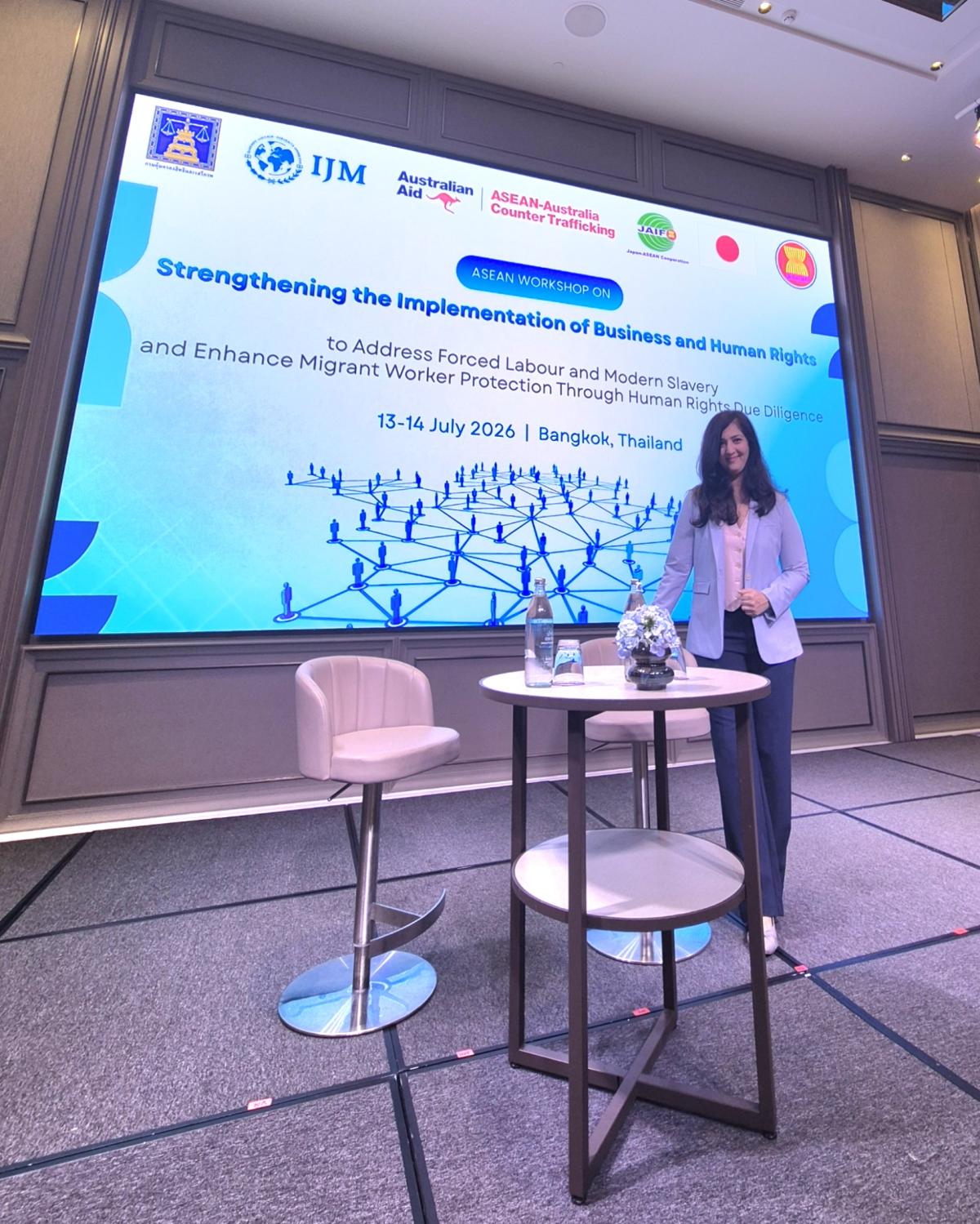
Sunway University’s Centre for Commercial Law and Justice (CCLJ) contributed to regional discussions on business and human rights when Associate Professor Dr Priya Sharma, Head of CCLJ, was invited to speak at the ASEAN Workshop on Strengthening the Implementation of Business and Human Rights to Address Forced Labour and Modern Slavery.
Held by the ASEAN Intergovernmental Commission on Human Rights (AICHR) Thailand in Bangkok from 13 to 14 July 2026, the workshop brought together participants to discuss how ASEAN countries can strengthen regional approaches to tackling forced labour, modern slavery and other forms of labour exploitation.
Dr Priya contributed to a session on “Strengthening Regional Cooperation in Judicial and Non-Judicial Mechanisms”, focusing on some of the challenges faced when labour exploitation crosses national borders.
Labour migration and supply chains are increasingly transnational. Workers may be recruited in one country, employed in another and contribute to products or services for companies based elsewhere. However, when exploitation occurs, legal accountability often remains fragmented across national systems. This gap can make it difficult for affected workers to access effective remedies.
In her contribution, Dr Priya highlighted the role that commercial law can play in strengthening corporate accountability. She pointed to areas such as company law, contracts and corporate obligations as important tools that can be used to encourage responsible business practices and create greater accountability.
She also emphasised that corporate accountability frameworks need to be connected to meaningful enforcement. Human rights due diligence, ESG reporting and grievance mechanisms can play an important role, but their impact depends on whether they lead to meaningful action and consequences when rights are violated.
Another key issue raised was access to remedy for migrant workers. Barriers such as language, cost, fear and jurisdiction can make existing legal mechanisms difficult to navigate. Strengthening cross-border access to remedy is therefore an important part of addressing labour exploitation in the region.
The discussion also considered the role of businesses and other market actors, including insurers, investors and consumers, in influencing corporate behaviour and advancing human rights expectations across supply chains.
The workshop provided an important platform for regional exchange on the implementation of business and human rights principles, while highlighting the need for stronger cooperation across jurisdictions. As supply chains increasingly operate across borders, effective accountability requires greater coordination between legal systems, businesses and other stakeholders.
Dr Priya was joined on the panel by Andika Ab Wahab and Sumitha Kishna, with the discussion led by Edmund Bon Tai Soon.
Sunway University is grateful to AICHR Thailand and the organisers for the opportunity to contribute to this important regional conversation and to engage with fellow practitioners and experts working to strengthen business and human rights protections across ASEAN.
Gallery