

Overview
Mechatronic Engineering (Robotics) programme focuses on the integration of mechanical, electronic and computer control, which addresses the engineering needs of Industry 4.0. This programme is also structured for specialisation in robotics engineering.
The programme prepares graduates to be ready for the future workforce with a strong focus on Artificial Intelligence and Industrial Automation. Throughout the programme, emphasis on sustainability and real-world learning is achieved through the incorporation of industry-related and UN SDG-related project-based learning. Students explore sustainable solutions to real-world problems by employing technologies such as AI, Data Analytics, Industrial Automation, Robotics and Internet-of-things.
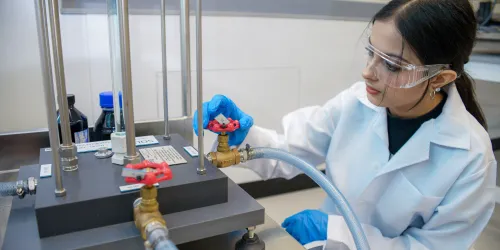
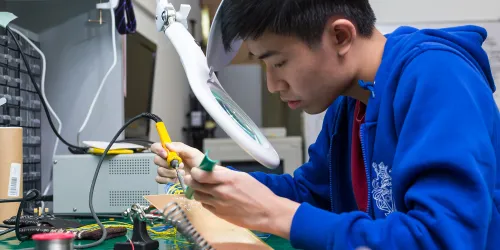
This programme is supported by laboratory facilities that are developed with industry partnerships i.e. the Collaborative Robots and Industrial Automation Laboratory and Mobile Robotics Laboratory.
Programme Educational Objectives (PEO)
PEO 1: Graduates progress as competent mechanical engineering professionals or leaders in their profession or related fields.
PEO 2: Graduates embrace lifelong learning to maintain and enhance their knowledge and competence through interdisciplinary education relevant to industrial and academic careers.
PEO 3: Graduates practice sustainability, professional conduct, and ethics for the betterment of society and environment.
Programme Learning Outcomes (PLO)
PLO 1: Engineering Knowledge – Apply knowledge of mathematics, natural science, computing and engineering fundamentals, and a mechanical engineering specialization as specified in WK1 to WK4 respectively to develop solutions to complex engineering problems.
PLO 2: Problem Analysis – Identify, formulate, research literature and analyze complex mechanical engineering problems reaching substantiated conclusions using first principles of mathematics, natural sciences and engineering sciences with holistic considerations for sustainable development (WK1 to WK4).
PLO 3: Design/Development of Solutions – Design creative solutions for complex mechanical engineering problems and design systems, components or processes to meet identified needs with appropriate consideration for public health and safety, whole-life cost, net zero carbon as well as resource, cultural, societal, and environmental considerations as required (WK5).
PLO 4: Investigation – Conduct investigation of complex mechanical engineering problems using research methods including research-based knowledge, including design of experiments, analysis and interpretation of data, and synthesis of information to provide valid conclusions (WK8).
PLO 5: Tool Usage – Create, select and apply, and recognize limitation of appropriate techniques, resources, and modern engineering and IT tools, including prediction and modelling, to complex mechanical engineering problems (WK2 and WK6).
PLO 6: The Engineer and the World – Analyze and evaluate sustainable development impacts to: society, the economy, sustainability, health and safety, legal frameworks, and the environment, in sharing knowledge and solving complex mechanical engineering problems. (WK1, WK5, and WK7).
PLO 7: Ethics – Apply ethical principles and commit to professional ethics and norms of mechanical engineering practice and adhere to relevant national and international laws. Demonstrate an understanding of the need for diversity and inclusion (WK9).
PLO 8: Individual and Collaborative Team Work – Function effectively as an individual, and as a member or leader in diverse and inclusive teams and in multidisciplinary, face-to-face, remote and distributed settings (WK9).
PLO 9: Communication – Communicate effectively and inclusively on complex mechanical engineering activities with the engineering community and with society at large, such as being able to comprehend and write effective reports and design documentation, make effective presentations, taking into account cultural, language, and learning differences.
PLO 10: Project Management and Finance – Apply knowledge and understanding of engineering management principles and economic decision-making and apply these to one’s own work, as a member and leader in a team, and to manage projects in multidisciplinary environments.
PLO 11: Life Long Learning – Recognise the need for, and have the preparation and ability for independent and life-long learning, adaptability to new and emerging technologies and critical thinking, and knowledge sharing in the broadest context of technological change (WK8).
“The Sunway University Bachelor of Mechatronic Engineering (Robotics) with Honours (BEng Hons) degree is recognised as equivalent to that of Lancaster University's Master of Engineering Mechatronic Engineering (Robotics) (MEng Hons) degree. Upon successfully completing the programme, Sunway University BEng Hons degree graduates will also be awarded the MEng Hons degree from Lancaster University. They will be awarded two certificates, making them graduates of both Sunway University and Lancaster University.”

- Automation Engineer
- Construction M&E Engineer
- Electronic engineer
- Field Service Engineer
- Instrumentation Engineer
- Mechanical Design Engineer
- Mechatronics Project Engineer
- Product Engineer
- Project Engineer
- Researcher
- Robotics Engineer
- RM39,300
for Malaysian students
- USD9,663
for international students

Programme Structure
Year 1
Year 2
Year 3
Year 4
Year 4 Electives (Choose 1)
Additional MOHE compulsory General Studies subjects
For Local Students
- Appreciation of Ethics and Civilisation
- Bahasa Kebangsaan A (applicable to students who did not sit for SPM or did not obtain a Credit in SPM Bahasa Melayu)
- Community Service for Planetary Health
- Entrepreneurial Mindset & Skills
- Integrity & Anti-Corruption
- Philosophy and Current Issues
For International Students
- Appreciation of Ethics and Civilisation
- Community Service for Planetary Health
- Entrepreneurial Mindset & Skills
- Integrity & Anti-Corruption
- Malay Language for Communication 2

Entry Requirements
STPM
CGPA 2.00 (including Mathematics & one Natural Sciences subject with minimum Grade C)
A-Level
Minimum 12 points (including Mathematics & one Natural Sciences subject with minimum Grade D)
Note: For A-Level points calculation
A = 10 points
B = 8 points
C = 6 points
D = 4 points
E = 2 points
Australian Matriculation
Pass with minimum ATAR 65 (including Mathematics Methods and one Natural Sciences subject)
Canadian Matriculation
Pass with minimum 65% (including Advanced Functions, Calculus & Vectors and one Natural Sciences subject)
Monash University Foundation Year
Pass with minimum 65% (including Mathematics and one Natural Sciences subject)
Sunway Foundation in Science & Technology
Pass with minimum CGPA 2.50 (including Mathematics and one Natural Sciences subject)
Unified Examination Certificate (UEC)
Maximum 26 points from 5 subjects (all grade Bs including Mathematics and one Natural Sciences subject)
Sunway Diploma
Pass with minimum CGPA 2.50 from any diploma in Engineering, Science or Technology
Matriculation/Foundation
Pass with minimum CGPA 2.50 (including Mathematics and one Natural Sciences subject)
IB Diploma
Completed with minimum 25 points (excluding bonus points) (including Mathematics and one Natural Sciences subject)
Other Qualifications
Pass with minimum CGPA 2.50 equivalent and any other qualifications will be considered on a case-to-case basis.
An APEL.A Certificate (APEL T-6) (Recognition of Prior Learning)
(Click on this link for further information on APEL.A)
Specific Requirements
- Good principal passes in Natural Sciences subjects. Natural Sciences subjects are Physics, Biology or Chemistry. Physics will be given preference.
English Language Requirements
- IELTS or equivalent 6.0 or equivalent
- MUET Band 4
- SPM English B
- UEC English B6
- O-Level English (1119) Credit
- Sunway Intensive English Programme (IEP) Pass Level 4 with minimum 65%
- ESL/English Satisfactory level at Pre-University programmes with English as the medium of instruction.
Scholarships and Financial Aid
For more information about the scholarships and financial aid, please visit the SEG Scholarships website.



Ask a question
If you’d like to know more about studying at Sunway University, we’d love to hear from you.