


Sustainable Practices Targets
SDG 11.4.1
Sunway University remains committed to strengthening sustainable mobility within the campus and the surrounding Bandar Sunway township. Consistent with the Sustainability Policy (2021, reviewed 2025), the University continues to promote low-carbon commuting modes, reduce reliance on private vehicles, and enhance accessibility and safety for all commuters. These initiatives are aligned with Clause 5.1.1 of the Sustainability Policy, which commits the University to achieving Net Zero Carbon emissions by 2030, supported by clear interim targets.
Clause 5.1.1 Sustainability Policy (2021, reviewed 2025)
The University will pursue the achievement of Net Zero Carbon emissions by 2030, with clear interim targets to guide emission reduction efforts.
In addition, Clause 5.2.7 reinforces the University’s commitment to enhancing infrastructure for low-carbon transportation, including the promotion and facilitation of electric-vehicle use and the provision of dedicated charging stations.
Clause 5.1.1 Sustainability Policy (2021, reviewed 2025)
Infrastructure for low-carbon transportation will be enhanced, including promoting and facilitating the use of electric vehicle and availability of dedicated charging stations.
Sustainability Policy (2021, reviewed 2025)
To guide progress toward these commitments, the University conducts annual assessments of commuting patterns, parking-utilisation records, shuttle-ridership monitoring, and observations of active-mobility infrastructure. In 2024, the proportion of single-occupancy vehicle commuters remained at 94%, consistent with the 2023 baseline, despite a 24% increase in campus population. This stability indicates effective vehicle-management interventions and contributed to an estimated 17% reduction in carbon emissions relative to what would have occurred if single-occupancy vehicle usage had increased proportionally with population growth.
| Year | 2022 | 2023 | 2024 |
| Campus Population | 6,103 | 5,882 | 7,283 |
| Number of Electric-Vehicles (EV) Entered per Day | 20 | 50 | 98 |
| Number of Bicycle/Scooter Entered per Day | N/A | 30 | 33 |
| Proportion of Single-Occupancy Vehicle Commuters | N/A | 94% | 94% |
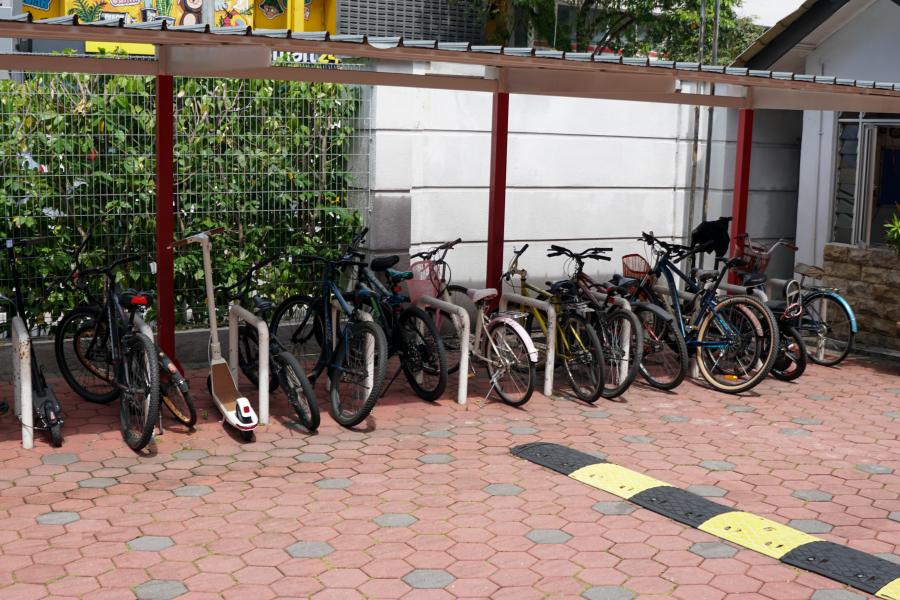
Electric-vehicle uptake continued to improve: 98 electric vehicles entered the campus in 2024 compared to 50 in 2023, reflecting strengthened campus support for EV adoption and the growing availability of charging facilities. Active mobility also increased, with the number of bicycle users rising by 10% and bicycle-rack occupancy reaching nearly 100% in 2024, demonstrating growing interest in non-motorised commuting options.

The University continues to implement a range of initiatives to strengthen sustainable commuting.
1. No-increment policy for parking spaces
A no-increment policy for parking spaces limits further growth in single-occupancy vehicle use. Since 2016, the University has consistently refrained from increasing parking spaces, despite a rise in the number of campus population. No open areas have been converted into parking, as the University has focused on reducing the volume of private vehicles entering and exiting campus.
| Year | 2022 | 2023 | 2024 |
| Campus Population | 6,103 | 5,882 | 7,283 |
| Total Parking Bays Available on Campus | 1,134 | 1,134 | 1,134 |
| Parking Bays per 100 Person | 18 | 19 | 15 |
2. Free shuttle bus service
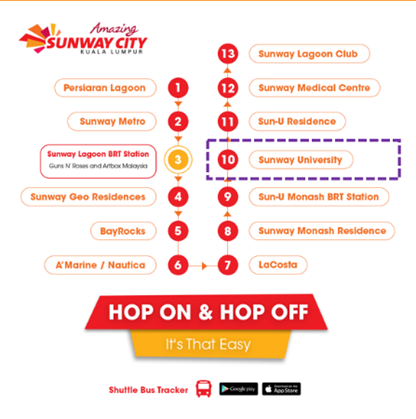
A free shuttle service connecting the campus to public-transportation nodes provides a reliable low-carbon alternative for students, staff and visitors with routes covering student residences, nearby residential areas and local attractions such as the shopping mall, theme park, and hospital.

3. The Canopy Walk
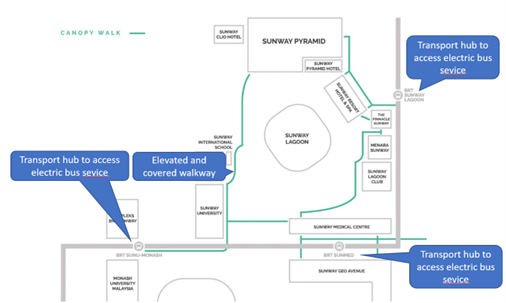
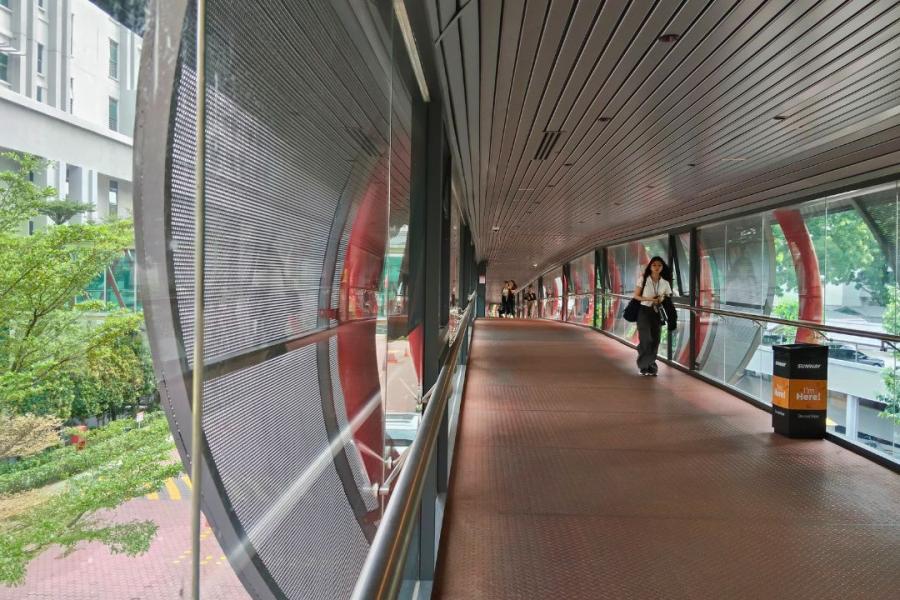
The Canopy Walk offers a safe, shaded, and pedestrian-friendly route linking the campus with key township facilities, encouraging students, staff and visitors to walking in place of short vehicle trips. This Canopy Walk links the University to the elevated pedestrian walkway system across Bandar Sunway, providing sheltered access to nearby amenities, including other universities, the hospital, mall, and surrounding commercial and residential areas.
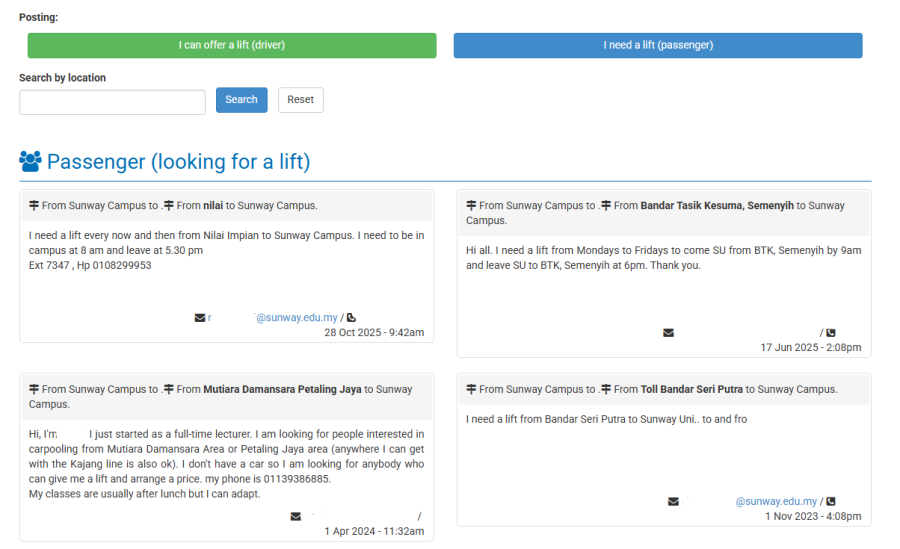
4. Carpooling programme
The University’s carpooling programme further reduces the need for individually driven vehicles through designated parking bays and awareness initiatives.
5. Cycling and micro-mobility supports
Cycling and micro-mobility are supported through well-utilised bicycle racks and secure parking, as demonstrated by near-full occupancy in 2024.
Looking ahead, Sunway University will continue to enhance its sustainable-mobility infrastructure in alignment with the 2030 Net Zero Carbon goal and the commitments under the Sustainability Policy (2021, reviewed 2025). Future enhancements will focus on expanding electric-vehicle charging infrastructure, increasing support for active-mobility users, strengthening data-collection systems, and developing additional commuting-related targets that contribute meaningfully to the University's broader emissions-reduction strategy.


